
Scores of Tibetans staged a vociferous protest and clashed with police outside Hyderabad House, the venue for the bilateral talks between Chinese President Xi Jinping and Prime Minister Narendra Modi on Thursday.

Chinese President Xi Jinping arrived in Ahmedabad on Wednesday to a grand welcome. He is India on a three-day visit which will focus on significantly ramping up trade and investment, besides addressing the contentious border issue that has seen occasional flare ups between the two Asian giants.

China's ruling Communist Party on Monday unveiled a new generation of leadership, including Xi Jinping and Li Keqiang, as members of the key Central Committee of CPC to lead the party and country for the next five years.

Important for Chinese President Xi Jinping will be Zhao's discussions on the issues of Tibet and the Dalai Lama and his assessment of the likely results of India's coming national elections, notes former senior RA&W officer and China expert Jayadeva Ranade.

Former US National Security Adviser John Bolton has stated that China is not prepared to back India's bid for a permanent seat on the UN Security Council. He highlighted that any expansion of permanent membership would require a UN Charter amendment, which China could veto. Bolton also discussed the broader institutional challenges facing the UN and suggested that regime change in Iran is crucial for long-term stability in West Asia, linking Houthi attacks to Iran's "ring of fire" strategy.
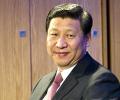
Investment announcement for $100 bn over 5 years likely.

United States Treasury Secretary Scott Bessent has warned that Iranian airlines could be effectively shut out of international travel from Wednesday, September 23, as Washington threatens secondary sanctions against foreign companies that continue providing services to Iran's carriers.

India would confront a more entrenched China, a less dependable United States, and a regional order increasingly shaped by great-power bargaining over which it exercises limited influence, notes Amberish K Diwanji.

Prime Minister Narendra Modi hosted a gala dinner for BRICS Summit leaders and delegates at Bharat Mandapam. The menu featured a range of Indian delicacies, including starters like 'khandvi mille' and 'khumb galouti', main courses such as 'paneer lababdar' and 'gucchi marmik', and desserts like 'shahtoot phirni'. The dinner was accompanied by a cultural performance.
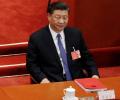
President Xi is also skipping the ASEAN (Association of Southeast Asian Nations) and East Asia summits in Jakarta this week.

United States President Barack Obama took up with visiting Chinese Vice President Xi Jinping his concerns over the human rights situation in China, which has experienced a recent surge in unrest among the Tibetan community.

The US House of Representatives has passed the Lindsey O Graham Sanctioning Russia and Iran Act of 2026, authorising President Trump to impose sanctions on Russia's energy sector and tariffs on countries like India and China that purchase Russian oil and gas. The legislation aims to curb Russia's ability to evade existing sanctions and reduce global dependence on its energy exports, despite some Democratic opposition to increased tariff authority for the President.

The Congress party criticised the all-vegetarian menu served at the BRICS Summit gala dinner hosted by Prime Minister Narendra Modi, with Rahul Gandhi highlighting that 80% of Indians are non-vegetarian. The party accused the BJP government of imposing its dietary preferences and questioned why India's diverse culinary culture was not showcased.
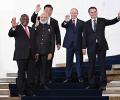
Chinese President Xi Jinping will attend the 13th BRICS summit to be held on Thursday at the invitation of Prime Minister Narendra Modi, China's foreign ministry announced in Beijing on Wednesday.

The US-China rapprochement, however tenuous, is not without implications for India. Both China and Pakistan have become closer to the US, notes Ambassador T P Sreenivasan.

Indian and Japanese ships engaged in advanced level exercises in all three domains of maritime warfare -- surface, sub surface and air.

Prime Minister Narendra Modi and US President Donald Trump held a telephone conversation to review progress in bilateral ties, covering trade, defence, and energy, against the backdrop of heightened trade friction due to the 'Lindsey O. Graham Sanctioning Russia and Iran Act of 2026'.

In July, tension emerged in Taksing, a remote village in the Upper Subansiri district of Arunachal Pradesh after locals sighted PLA soldiers.

Russian President Vladimir Putin has arrived in India for a three-day visit to attend the BRICS summit and hold bilateral talks with Prime Minister Narendra Modi, focusing on expanding trade, investment, and energy cooperation amidst global geopolitical challenges.
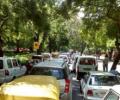
Traffic snarls were on Thursday reported from different parts of central and south Delhi after some roads were closed for the movement of Chinese President Xi Jinping, who is in India on a three-day trip.

Two former Chinese defence ministers, Wei Fenghe and Li Shangfu, were sentenced to death with a two-year reprieve over graft charges, official media reported.
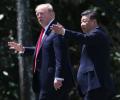
In a message to Trump, Xi, 67, said that after learning US President Trump and Melania have tested positive for COVID-19, he and his wife Peng Liyuan extend sympathy to them and wish them a speedy recovery, state-run Xinhua news agency reported.

China's Foreign Ministry has refuted allegations of providing military support to Iran, warning the US against imposing tariffs based on these accusations. The statement follows reports of Iran acquiring a Chinese satellite for targeting US military bases. Meanwhile, a rescheduled meeting between Presidents Trump and Xi Jinping is set for May.

Malaysian Prime Minister Anwar Ibrahim's impromptu rendition of Kishore Kumar's classic 'Khwab Ho Tum Ya Koi Haqeeqat' has captivated audiences online, with a video of his performance garnering over a million views and widespread appreciation.

India's IT Ministry sources state the country will not slow down its Artificial Intelligence development, distinguishing its focus on people-centric applications from global concerns over frontier models. The government acknowledges AI safety risks and is tightening incident reporting norms, with IT Minister Ashwini Vaishnaw emphasising regulation for user safety.

Trump also praised Chinese President as "a great leader of a great country" and said the two sides had "already agreed to a lot of things."
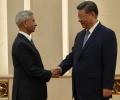
External Affairs Minister S Jaishankar met Chinese President Xi Jinping and apprised him of recent developments in India-China bilateral ties during the Shanghai Cooperation Organisation (SCO) Foreign Ministers' meeting in Beijing.
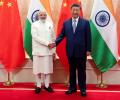
India has asserted that the state of its border with China directly impacts the broader bilateral relationship, emphasising the critical importance of maintaining peace and tranquillity along the Line of Actual Control (LAC). The Ministry of External Affairs also firmly rejected China's claims over Arunachal Pradesh, reiterating its status as an integral part of India. This stance was reiterated during a recent Working Mechanism for Consultation and Coordination meeting, where both sides agreed to continue using diplomatic and military channels to resolve outstanding issues.
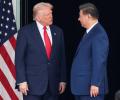
United States President Donald Trump said that China 'knows the consequences' if it attacks Taiwan, asserting that Chinese President Xi Jinping understands the situation 'very well'.

The successful hosting of the 18th BRICS summit in New Delhi has provided a significant boost to the BJP, offering a timely opportunity to strengthen its narrative against the opposition ahead of crucial assembly elections next year. BJP sources highlight the BRICS grouping's strong condemnation of the Pahalgam terror attack and the consensus declaration as major diplomatic victories for the Modi government, countering criticisms of its foreign policy. The party plans to leverage these outcomes during its month-long Seva Sankalp campaign to connect with various sections of society.

'The notion of a single unarmed town challenging the might of the People's Republic is a little absurd,' says Mihir Sharma.
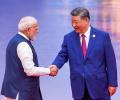
India and China held diplomatic talks to review the situation along the Line of Actual Control (LAC), discussing boundary delimitation, border management, and trans-border cooperation. Both nations stressed the importance of maintaining peace and tranquillity for bilateral relations and agreed to continue using existing channels to resolve outstanding issues.

BRICS nations have successfully reached a consensus on a joint statement following extensive negotiations, with India playing a crucial role in bridging differences, particularly among West Asian members like Iran, Saudi Arabia, and the UAE, despite regional conflicts and geopolitical tensions.

India and China are in what experts call 'a cooperation-versus-competition situation'.

'The Chinese military cannot advance much in Ladakh, even if they want to.' 'Similarly, in Arunachal Pradesh, they can rename a village or two, intrude here or there, but cannot do much more realistically.'

Chinese President Xi Jinping on Saturday asked the United States to "play a constructive role" in maintaining peace and stability in the disputed South China Sea, asserting that Beijing will "unswervingly" safeguard its sovereignty over the area.

Check out these images from the Shanghai Cooperation Organisation summit in Tianjin, China, on Monday morning featuring Prime Minister Narendra Modi, Chinese President Xi Jinping and Russian President Vladimir Putin, taking bon homie to a new level.

China on Friday said the collapse of a high-altitude glacier in Nepal may have triggered the massive flash flood disaster that engulfed the Tibet-Nepal border, killing hundreds and causing widespread damage.

Following his visit to China, US President Donald Trump has suggested a potential shift in Washington's approach to Taiwan, expressing reluctance to engage in military conflict over Taiwan's independence and cautioning against unilateral moves.

Xi Jinping will visit Pakistan this year after a cancelled a trip in 2014.
